REVIEW · VENICE
Verona City Sightseeing Walking Tour of Must-See Sites with Local Guide
Book on Viator →Operated by Private Tours of Venice · Bookable on Viator
Two hours in Verona, and the city starts talking. I like that you get a local guide to connect the dots fast, plus the route lands you at the Romeo and Juliet balcony-inspired spot without the planning headache.
One caution: the tour is built around walking and group pacing, and a few people noted moments where the commentary didn’t always feel loud or detailed enough.
With a small group capped at 10, you can usually ask questions and keep moving at a steady pace. That said, you’ll still be outdoors on a timeline of about 2 hours, so bring the usual city-walker stamina and an ear ready for street noise.
In This Review
- Key highlights worth your attention
- Before you go: what this Verona walk really delivers
- Piazza Bra: starting at Verona’s main heart
- Piazza delle Erbe: the “collage” square where eras sit together
- Piazza dei Signori (Dante’s Square): politics, poets, and the Lords’ tombs
- The Romeo and Juliet balcony-inspired moment: the story meets the streets
- How the guide changes everything (and what to do if you can’t hear)
- Walking routes, pacing, and why “small group” matters here
- Price and value: what $43.54 buys you in Verona
- When to book and what to expect with timing
- Who this tour suits best (and who might want a different style)
- Should you book this Verona walking tour?
Key highlights worth your attention
- A compact 2-hour route that hits the core squares without turning into an all-day slog
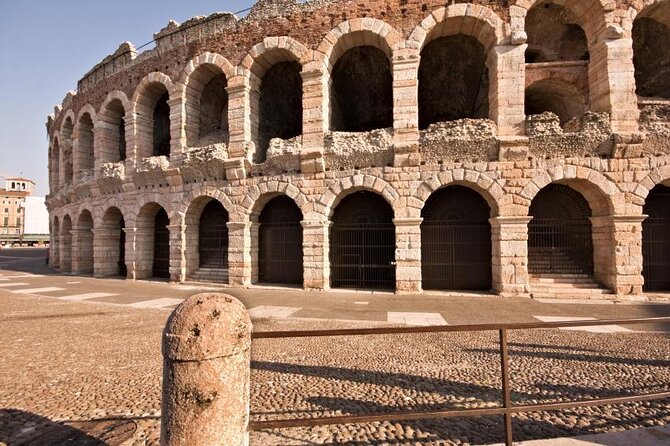
- Piazza Bra + the Arena-area views that anchor Verona’s Roman-era reputation
- Piazza delle Erbe’s layered buildings, where styles from different eras sit side by side
- Dante’s Square and the Lords of Verona graves for a darker, sharper side of the town
- Romeo and Juliet balcony-inspired stop that turns a famous story into real streets and stone
- Small-group format (max 10), which helps you actually interact instead of just following
Before you go: what this Verona walk really delivers
This tour is for people who want Verona’s big landmarks and the stories behind them, without having to study a map for hours. You’re looking at an outdoor, guided walking loop that moves through the center at a comfortable pace. The timing works well if Verona is a stop on a longer trip and you still want more than a quick photo pass.
The best part, in my opinion, is the pairing of famous sites with the kind of context that makes them make sense. You don’t just see the Arena-area surroundings; you hear how Verona’s buildings shifted over time and why certain places matter. And because the group size stays small—10 maximum—the guide can keep things moving while still answering questions.
Value-wise, you’re paying for a local guide’s time and an efficient route. At $43.54 per person, it isn’t a “cheap and cheerful” stroll, but it’s also not pricing itself like a private driver-and-guide setup. If you’re the type who likes your landmarks explained while you walk, this is where that money tends to pay off.
You can also read our reviews of more walking tours in Venice



Piazza Bra: starting at Verona’s main heart
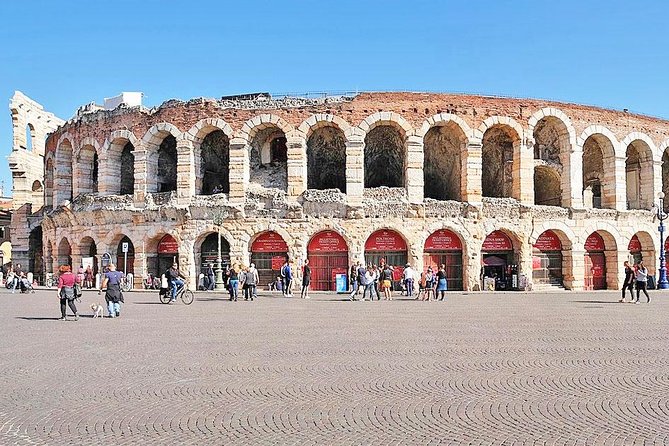
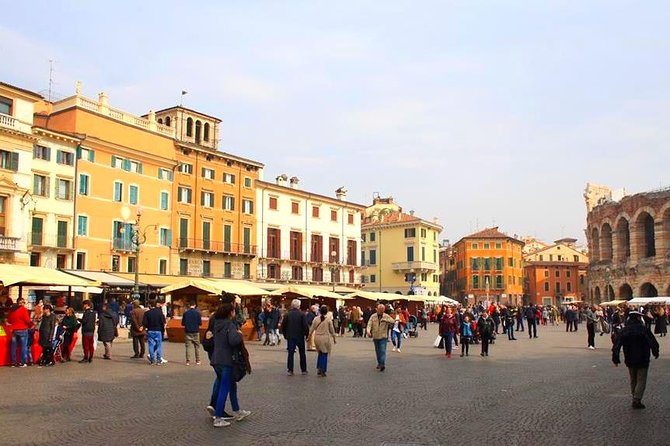
You meet at Farmacia Internazionale, Piazza Bra 28. From the start, the energy is right: Piazza Bra is Verona’s core, and it sets the tone for the whole tour. The guide gives you a quick orientation so you don’t feel like you’re wandering in circles.
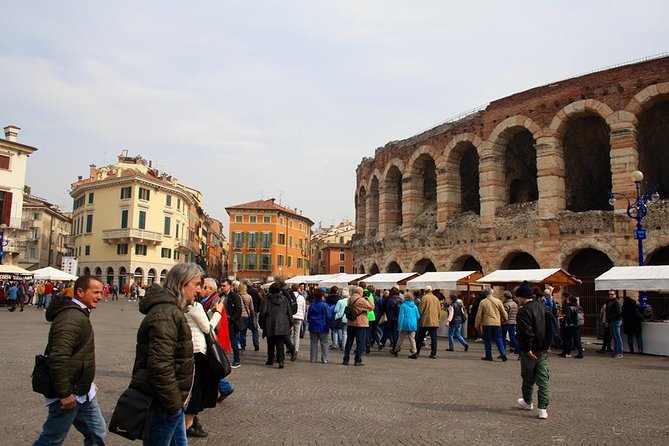
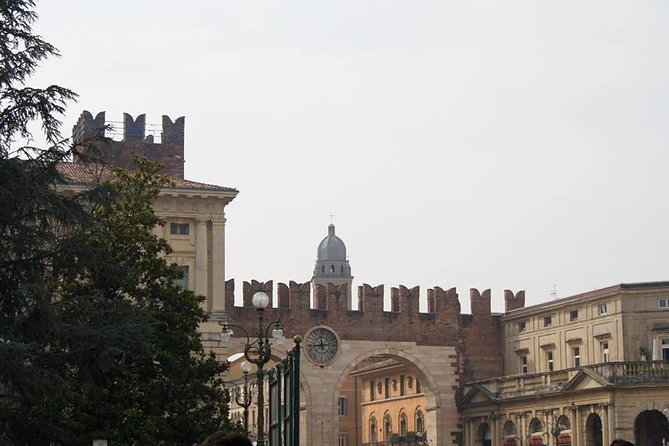
The stop here centers on the Arena-area—described as the famous and largest amphitheatre of Italy—and on a nearby historical building that today functions as the Town Hall. The key idea is that you’re standing in a space where Verona’s layers overlap: Roman-scale architecture nearby with later civic power in the same neighborhood.
Practical take: Piazza Bra can feel open and windy. If you’re sensitive to cold or heat, this is where you’ll want a layer or sun protection. Also, because this is the first stop, it’s the moment to ask any “how does the city work” questions before the route pulls you deeper into the center.
Piazza delle Erbe: the “collage” square where eras sit together
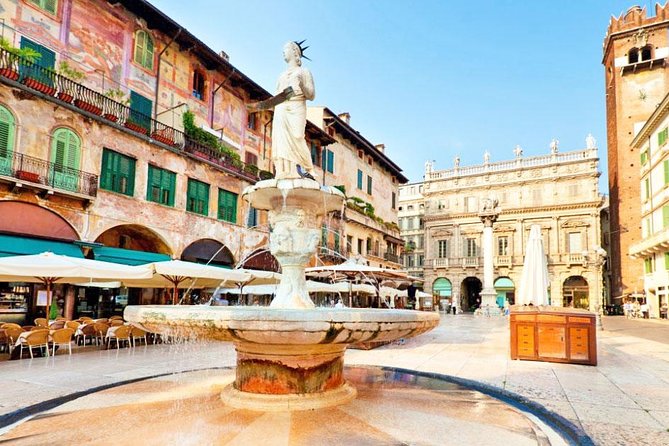
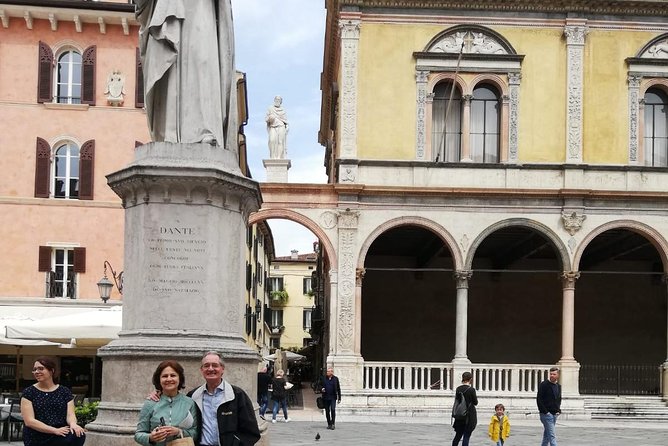
Next comes Piazza delle Erbe, often described as one of Italy’s most beautiful squares. The important detail here isn’t just the scenery—it’s the way the square is built like a timeline. The stops focus on how statues, palaces, and architectural details from different periods are layered together, creating a visual collage that feels more real than a museum display.
This is a great moment for two reasons. First, it’s the kind of place where you can slow down even during a short tour, because there’s always something to notice at eye level. Second, the guide’s job is easier here: when the architecture is openly mixed, it’s simpler to explain how Verona changed without sounding like a lecture.
If you’re the type who gets bored by repetitive “this is old, that is older” tours, Piazza delle Erbe usually fixes that. It’s not just a view; it’s a story you can walk around.
Piazza dei Signori (Dante’s Square): politics, poets, and the Lords’ tombs
From there, the route heads to Piazza dei Signori, also called Dante’s Square. This area brings a more serious mood. You’re still in the middle of town, but the atmosphere shifts because the focus is on power—who ruled, who mattered, and what left a mark.
The stop includes the graves of the Lords of Verona. That single detail changes how you read the stone around you. Instead of seeing the square as a pretty backdrop, you start seeing it as a place tied to rule and legacy.
Time here is shorter than Piazza delle Erbe, so it helps to keep your questions brief and pointed. If you want more detail on the people connected to these sites, this is a good place to ask—then you’ll have better context for the rest of the walk.
The Romeo and Juliet balcony-inspired moment: the story meets the streets
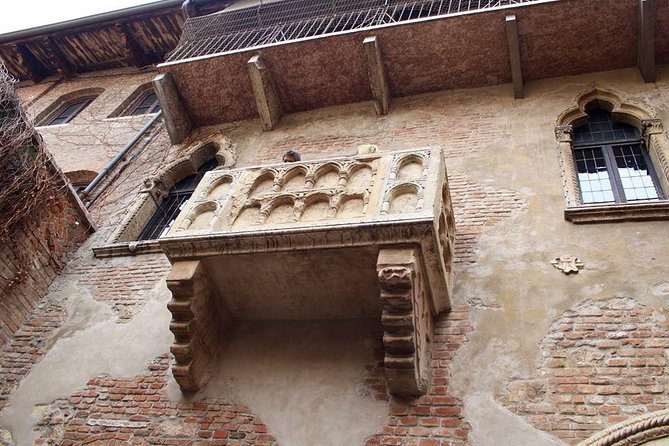
The highlight list calls out a visit to the balcony that inspired Romeo and Juliet. Even if you know the tale already, the value on a walking tour is that you’re not just looking at a landmark—you’re getting the local explanation for why the story is attached to these specific streets.
This stop also helps break up the “squares only” feeling. Verona’s center is compact, so a guide’s job is to make the landmarks feel connected rather than random. The Romeo-and-Juliet moment usually does that by turning a worldwide pop-culture reference into something you can place on a real map of neighborhoods and architecture.
One note to keep your expectations sensible: the exact depth of time spent here can vary with pacing, and this tour’s main schedule is about the loop through major sites. Still, if Romeo and Juliet is part of why you’re in Verona, this is the part you’ll remember later.
You can also read our reviews of more guided tours in Venice




How the guide changes everything (and what to do if you can’t hear)
A big theme across the experience is the role of the guide. Names that come up often include Laura and Luisa—and the common pattern is strong storytelling and a clear sense of Verona’s built environment. Many people also mention that routes can take you through parts of the center you might otherwise miss.
That said, walking tours are only as good as the guide’s audibility and energy. Some feedback points to occasions with long gaps of silence, and at least one person felt they couldn’t hear the guide clearly enough. This isn’t a deal-breaker, but it is something you should plan around.
My practical tip: position yourself close to the guide early. If you lose the sound through street noise, don’t just stand still—move a step or two so you’re within a comfortable listening distance. And if you’re easily distracted by crowds, pick a spot at the front third of the group rather than the back.
Also, one practical annoyance got a real-world fix: if the guide is hard to find, one tip is to look for a tall pole with VIATOR written on it.
Walking routes, pacing, and why “small group” matters here
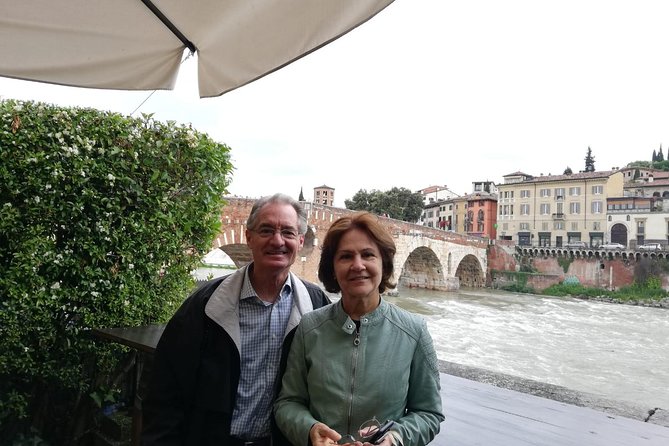
This tour caps at 10 travelers, and that size is a sweet spot. Small enough to keep questions from disappearing into the group, but large enough to keep energy up while walking between squares. In real terms, it means you’re less likely to feel like you’re being herded at full speed.
It also helps with the “where do we go next” stress. You’re not navigating independently through a compact historic center while also trying to remember which corner had the nicest view. A good guide keeps the flow tight, and several people specifically highlight that the tour avoids some of the heaviest crowd pressure by taking alternate routes.
You can think of this as Verona’s highlights, but delivered with local steering. If you want the sites plus the “why,” small group pacing is the difference between a decent stroll and a memorable orientation.
Price and value: what $43.54 buys you in Verona
At $43.54 per person for roughly 2 hours, you’re buying three things:
- A local guide who connects what you see to how the city evolved
- A structured route through major squares rather than an open-ended walk
- A group experience where you can ask questions without planning time
What you’re not getting is food or a sit-down meal. Food and drinks are not included, and there’s no lunch built into the schedule. That’s actually a plus if you like choosing your own pace for lunch or a late aperitivo.
Also note: the listed stops include free admission for Piazza Bra, Piazza delle Erbe, and Piazza dei Signori. That helps keep the tour from turning into a hidden-ticket adventure. The famous landmarks are still the focus—you just aren’t paying extra entry fees at those points based on the information provided here.
So, is it good value? It tends to be if you’re the kind of person who likes context while walking. If you prefer silent wandering with a self-guided audio app, you may feel you could do it cheaper on your own. But if you want the “what am I looking at and why does it matter” answer while you’re standing there, the price is easier to justify.
When to book and what to expect with timing
On average, this tour gets booked about 21 days in advance, so if your Verona dates are fixed, it’s smart to plan early. The total time is listed as about 2 hours, so your schedule should leave room for a bit of walking between stops and a short time to soak in each square.
There’s also a weather factor. This is an outdoor walking tour, and the experience requires good weather. If you’re traveling in a shoulder season where rain is common, check your plans and be ready for date changes if conditions aren’t ideal.
Who this tour suits best (and who might want a different style)
This works especially well if:
- you’re in Verona for a short time and want a fast orientation
- you like hearing how places connect across eras
- you want a guide to take you through the center without route planning
It may feel less satisfying if:
- you prefer a very animated, nonstop speaking style all the way through
- you expect visits that include paid museum interiors (based on the listed stops, it’s more “see and learn” than “enter and tour”)
- you don’t enjoy walking for two hours in busy historic streets
If you’re traveling with kids, note that children must be accompanied by an adult. Service animals are allowed, and the start area is near public transportation.
Should you book this Verona walking tour?
I’d book it if you want a clean intro to Verona’s main squares plus a guided explanation that turns landmarks into a coherent story. The small group size and the presence of guides like Laura and Luisa show that the experience can go beyond surface-level sightseeing when the guide energy clicks with your style.
Skip it or consider another option if you’re someone who needs constant narration to stay engaged, or if you plan to spend most of your time photographing and wandering silently. This tour shines when you’re ready to listen, ask a question or two, and let the city’s center unfold one square at a time.